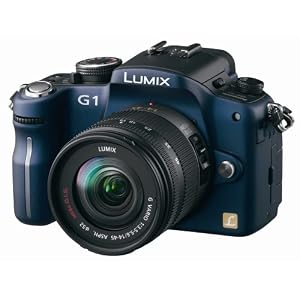
you're want to buy Panasonic Lumix DMC-G1 12.1MP Digital Camera with Lumix G Vario 14-45 mm f/3.5-5.6 ASPH Mega OIS Lens (Blue),yes ..! you comes at the right place. you can get special discount for Panasonic Lumix DMC-G1 12.1MP Digital Camera with Lumix G Vario 14-45 mm f/3.5-5.6 ASPH Mega OIS Lens (Blue).You can choose to buy a product and Panasonic Lumix DMC-G1 12.1MP Digital Camera with Lumix G Vario 14-45 mm f/3.5-5.6 ASPH Mega OIS Lens (Blue) at the Best Price Online with Secure Transaction Here...

other Customer Rating:

Price: $499.99 & this item ships for FREE with Super Saver Shipping. Details
read more Details
With the G1, Panasonic has evolved a totally new-concept digital camera that can take even greater advantage of the compactness and light-weight weight inherent inside Four Thirds System Standard. By enhancing the variety of electrical contacts between camera body and lens, Panasonic has also increased camera expandability and maximized the long run potential of the G1, including compatibility with future features. In addition, the versatile G1 accepts not only Micro Four Thirds System interchangeable lenses, but also conventional Four Thirds System lenses (when an optional adapter is mounted). This means that users can continue to use Four Thirds lenses they already own.
The G1 may be the world's first camera to employ the new Micro Four Thirds System standard. Together with an innovative mirror-less structure which also dramatically downsizes your camera body, the LUMIX G Micro System achieves a dramatic portability and ease of use by an adoption of electronic Full-time Live View Finder rather than conventional optical viewfinder. Despite the G1's ultra-compact design, it comes fully designed with features that assure outstanding simplicity of use, made possible from the contrast AF system. The G1 also boasts iA (Intelligent Auto) mode, a feature that took the entire world by storm in Lumix digital compact cameras. iA mode brings together an entire range of functions - led by AF Tracking , Face Detection, Intelligent ISO Control and Intelligent Exposure - that together let users take strikingly beautiful photos with maximum ease every time they shoot. The G1 breaks new ground in styling too, overturning SLR camera conventions by providing users a variety of body colors to select from. For those who happen to be hesitant about moving approximately an SLR camera, the G1 is really a perfect fit. It is really a small, sophisticated, easy-to-use camera which will greatly expand any user's photographic capabilities.
The G1's Live MOS sensor gives users the benefits of Full-time Live View both when viewing the Free-Angle LCD so when looking through the viewfinder. Other new conveniences made possible by the contrast AF include 1-area-focusing, AF Tracking, along with a preview functions that demonstrate the photographer how changing the shutter speed (and other settings) will affect the photograph. The large 3.0-inch free-angle LCD, with its 100 % field of view and sharp 460,000-dot resolution, lets the photographer check even fine details when composing an image or viewing an attempt just taken.
Behind the G1's exceptional image quality can be a 4/3-type 12.1-megapixel Live MOS sensor that boasts a large dynamic range and low power consumption, plus Panasonic's new Venus Engine HD imaging processor, featuring its superb noise reduction performance and expandability represented by HDMI output capability. Because dust entering our bodies is really a concern with all interchangeable lens cameras, Panasonic equipped the G1 with a Supersonic Wave Filter as part of your Dust Reduction System designed to prevent dust and other foreign matter from adhering on the image sensor.
In addition to accepting Micro Four Thirds lenses, the G1 might be fitted with a mount adapter which allows the use of standard Four Thirds lenses. This greatly expands the variety of lenses open to users. They can select lenses from your number of manufacturers and in the number of combinations, for virtually unlimited photographic capabilities. An extensive range of special accessories can be acquired too. The G1 also is equipped having a mini HDMI output terminal for easy connection along with other AV devices. With features like these, the G1 gives users a host of photographic and entertainment possibilities to explore.
The stylish Lumix DMC-G1 is definitely an entirely new sort of digital camera having an unprecedented feature set. Especially for people who have never before used an interchangeable lens camera, and for people that have tried one but didn't believe it is comfortable, the easy-to-use G1 can open the entranceway with a whole world of fun, beauty and unlimited creative possibilities.
Panasonic Lumix DMC-G1 Highlights
Ultra compact Digital Interchangeable Lens Camera: Granted from the Micro Four Thirds System Standard
With the G1, Panasonic introduces an innovative mirror-less structure that dramatically downsizes the camera body. The G1 is a lot more compact than conventional SLR camera around the market, thanks in large part on the Micro Four Thirds System, a fresh standard for interchangeable lens cameras. This new system has made it possible to relieve the flange back distance (between the mount as well as the image sensor) to approx. 20 mm--half the 40 mm specified within the Four Thirds System. The outside diameter in the mount can be reduced, by about 6 mm.
The Micro Four Thirds System makes it possible to downsize not exactly the camera body, however the lenses too--particularly wide-angle lenses and high-power zoom lenses--while maintaining the superior image quality characteristic in the 4/3 image sensor. The G1's ground-breaking structural design forever dispels the notion that an interchangeable lens camera has being big and heavy--a drawback that's deterred many people from switching to a digital SLR. Even featuring its generous 3.0-inch LCD, the G1 is quite compact--and there exists simply no compromise in function or performance.
Size comparison: G1 vs. L10
Another attractive feature that separates the G1 from conventional digital SLR cameras is the choice of body colors. While traditionalists can select the standard black body, others will benefit from the appealing blue and red colors available. With its exceptional mobility and features, the G1 offers a fresh type of photography; with its design and color selection, it includes a brand new sense of camera style.
Full-time Live View and Contrast AF
With the G1 users benefit from the attributes of Full-time Live View not not until viewing the LCD, but when with all the electronic viewfinder too. The G1's viewfinder system retains the outstanding viewability of an optical viewfinder and will also display details about camera settings how the user are able to see without taking their eye through the subject. This is a of the ways Full-time Live View uses digital technology to provide photographer useful new features and functions. Additionally to a mirror-less structure, the G1 includes a high-resolution 1,440,000-dot equivalent Live View Finder.
A clever built-in eye sensor automatically switches on the viewfinder when the user looks into it, then switches rid of it and turns for the 3.0-inch high-resolution 460,000-dot LCD (which boasts a broad viewing angle) in the big event the user looks away in the viewfinder. The 60-frames-per-second Live View is granted from the Live MOS sensor, which takes signals directly through the image sensor and sends them continuously on the LCD, in real time. It is possible to use either auto focus or manual focus while using the Full-time Live View.
Both the Live View Finder and LCD provide a 100 percent field of view. This allows the user, when composing a shot, to check the framing accurately from corner to corner.
The G1 introduces a new Contrast AF function that isn't only accurate and simple to use, but also very fast. Users can choose from a wide selection of AF modes, including multiple-area AF with as much as 23 focus areas, 1-area AF which has a selectable focus area, Face Detection, and AF Tracking. In the 1-area AF mode, the AF frame size might be changed simply by turning a dial. The G1 also features a Quick AF function that begins focusing as soon as the user aims the camera--no waiting for him or her to press the shutter button halfway. This gives a quicker focusing that might help capture the niche before the crucial moment passes. Continuous AF keeps the topic in focus at all times. With the G1's many auto focus modes, there's a choice that's just right for almost any shooting situation.
High-resolution Live View Finder and Free-angle 3-inch 3:2 460,000-dot LCD
A large, clear, easy-to-see LCD, that rotates 180 degrees horizontally and 270 degrees vertically is upgraded both in dimensions and resolution to be 3.0-inch with 460,000-dot high res to supply even more comfortable view for monitoring when shooting as well as for playing back the results. Extraordinary 3:2 aspect from the LCD on DMC-G1 is familiar to those who are utilized to analog film cameras. The G1 is made for easy viewing, wherever your photographic pursuits take you. When the lighting who are around you changes, the LCD changes too. the Auto Power LCD function automatically boosts brightness by around 40 percent, depending for the shooting condition. The LCD monitor remains an easy task to see whatsoever times. This can help make framing an attempt with Full-time Live View even easier.
The DMC-G1's Live View Finder has got the large 1.4x (0.7x on 35mm equiv.) magnification and also the 100-percent field of view since the optical viewfinders on high-end digital SLR cameras. This, in addition to the 1,440,000-dot equivalent resolution, helps it be all to easy to shoot the exact image the digital camera sees. Surprisingly, whenever you look in the viewfinder, a sensor automatically turns the Live View Finder on as well as the LCD off. You enjoy smoother, easier shooting without having to switch the setting of display.
Sure and straightforward framing in real time with approximately Completely field of view
In addition, customize the camera to match your shooting preference by changing the display style or switching to a full-screen display. The user enjoys a seamless 60fps Live View both around the LCD and LVF. The G1's Live View Finder, that is based on the field sequential system that uses RGB 3-independent sequential illumination to produce 180 fps for each of the three colors, provides the user a clear, natural and comfy view when framing a shot. The LCD can swivel 180 degrees horizontally and 270 degrees vertically, giving the user the flexibleness to adopt low-angle and high-angle shots easily and comfortably. The DMC-G1 also features the Quick Menu, so it is achievable to produce a variety of settings if you don't take your talent from the Live View Finder.
Great Photography Is Not Only from Professional Photographers Anymore--Intelligent Auto Mode
When you have no idea which mode will present you with the best shooting results, or when a sudden photo opportunity appears and you also don't possess time for you to make any settings, simply choose iA (Intelligent Auto) mode and allow camera do all this for you. This advanced mode includes MEGA O.I.S. to detect hand-shake, Intelligent ISO Control to detect subject movement, Face Detection to detect faces within the frame, Intelligent Scene Selector to detect scene conditions, Light Detection to detect the brightness level, and AF Tracking to continually track a moving subject and keep it in focus. These six functions work automatically and simultaneously in iA Mode to optimize your settings, rendering it easier than ever before to adopt beautiful photos every time.
Shake Detection--MEGA O.I.S.(Optical Image Stabilizer) MEGA O.I.S., implemented within the lens, compensates to the blurring caused by hand-shake. Even slight hand-shake movement is accurately detected by strategy for a sampling frequency of 4,000 times per second, and compensated to produce sharp, clear images. Additionally, it works for zoom shots and macro shots, that are especially susceptible to hand-shake, and lets you shoot in dimly lit rooms or evening illumination, with out a flash, to preserve the mood.
Motion Detection--Intelligent ISO Control The Intelligent ISO Control function detects subject movement and automatically adjusts the ISO setting and shutter speed to best suit the movement and light conditions. When it detects subject motion, it automatically raises the ISO setting and boosts the shutter speed to avoid motion blur. On the opposite hand, if the subject remains no movement is detected, it will take beautifully natural photos with a low ISO setting. Intelligent ISO Control provides you with stunning images easily because there is certainly no requirement for complicated settings.
Light Detection--Intelligent Exposure The Intelligent Exposure function raises the exposure only in under-exposed areas by detecting the brightness level part-by-part in the picture. If your background includes the sky, which tends to get easily washed out, the camera automatically adjusts the aperture and shutter speed to keep the setting slightly under-exposed to stop wash-out while brightening the darkened area by enhancing the ISO only because area. In the wedding the background of your indoor portrait receives insufficient lighting from the flash and becomes dark, the ISO sensitivity is raised in only the low-lit area to generate it brighter without causing graininess inside subject's face. When Intelligent Exposure is turned on, the icon changes from white to yellow. In addition, it can be done to adjust the consequence in three levels in normal shooting mode: high, normal, and low.
Face Detection AF/AE
Face Detection--Face Detection AF/AE the Face Detection function detects faces and automatically optimizes the main objective and exposure settings. It prevents the blurry faces that happen in the wedding the camera targets something facing or behind the subject, and keeps faces from appearing dark when shooting indoors or from the light source. It detects around 15 faces with a time, making it extremely convenient for group photos. When the camera detects a face, Face Tracking follows it even when the subject moves around. This causes it to be all to easy to capture the person's face quickly if he or she is moving. It's also designed with Digital Red-eye Correction. The camera takes care from the red-eye effect that usually happens when shooting using a flash, to make certain attractive facial expression always.
Scene Detection - Intelligent Scene Selector When the camera's in iA (Intelligent Auto) Mode, the Intelligent Scene Selector automatically sets the Scene Mode to either Scenery, Portrait, Close-up, Night Portrait or Night Scenery. The camera judges it from your various detection results for example focusing distance, inclusion of human face and brightness level with the circumstance. You cost nothing from annoying settings whenever scene changes when taking pictures with these most frequently used Scene Modes to have beautiful results even before you already know it.
Subject Detection--AF Tracking Simply focus on your own subject, then press the shutter button to activate AF Tracking. Even whenever you remove your finger in the shutter button, your camera will continue to automatically keep the moving subject in focus. This keeps the main focus sharp and blur-free when shooting active children or pets, too as when capturing sports scenes or subjects inside a moving object. It minimizes the shutter time lag so you'll not miss those spur-of-the-moment shots, so helping to offer you truly beautiful photos always.
The user can activate all of those useful, convenient shooting-assist functions simply by selecting iA mode. This makes all the DMC-G1 the ultimate, super-versatile automatic camera for capturing clear, beautiful, mistake-free photos effortlessly despite its good quality image rendering capability like a system camera.
A Host of Creative Options
My Color Mode is often a special option that offers free rein for the user's creativity. Within My Color mode it is possible to freely adjust the color, brightness and saturation parameters, while checking the Full-time Live View image to see how those adjustments affect the picture. This makes it easier plus more fun to create interesting, expressive images. Adjust the settings that best suit the shooting conditions and your expressive intent, then enjoy your personal photography.
Furthermore, the DMC-G1 provides options of picture taste while using function called Film Mode. Each analog film has its own characteristics including with color, contrast, gradation and which affects on the outcome in the picture, in other words, it's one from the ways of expression. With the DMC-G1, the Film Mode allows that you choose the one that takes the best advantage of the scene or the subject you're taking out of the total of nine film modes including Standard, Dynamic, Nature, Smooth, Nostalgic, Vibrant, Standard B/W, Dynamic B/W and Smooth B/W, with capability of fine adjustment of contrast, sharpness, saturation and noise reduction. Users may also shoot exactly the same scene in 3 different films using the new Multi Film mode. All these settings can be confirmed before you're taking the picture and also the result is usually because you intended.
The Full-time Live View lets the users confirm the outcome image beforehand after adjusting the shutter speed, aperture or white balance. The white balance could be adjusted in the part of two-axis of coordinates precisely. And also the white balance bracket in 3 pictures either in addition to A(amber)-B(Blue) axis or G(Green)-M(Magenta) axis has become designed for G1.
High Image Quality as an Interchangeable Lens System Camera The 4/3-type 12.1-megapixel Live MOS sensor featured within the DMC-G1 supplies the better of both worlds--the superior image quality of an CCD sensor, as well as the lower power consumption of a CMOS sensor. New technology that can make it possible to see 4 channels of data simultaneously likewise helps the G1 deliver 60 frames-per-second Full-time Live View images, while faithfully reproducing high-resolution images with fine detail and rich gradation.
For the style processing LSI, the brand new Venus Engine HD features exceptionally advanced signal processing capabilities. This sophisticated LSI separates chromatic noise from luminance noise and applies the optimal noise reduction to each, which means you capture clear and beautiful images even though shooting at high ISO sensitivity levels. The Venus Engine HD also provides independent gradation control per with the R, G and B colors, so even delicate color nuances are reproduced faithfully. Linking smoothly using the Live MOS sensor, the Venus Engine HD records stunning high-resolution 12-megapixel images with exceptional accuracy. Signals containing a large amount of image data are sent in the Live MOS sensor to the high-resolution Live View Finder, resulting inside the 1.44 million-dot equivalent sharp clear images at 60 fps. The Venus Engine HD also supports a thorough selection of functions, including HDMI output.
If dust or another foreign matter gets inside the camera if you are changing lenses, it could cling for the image sensor and show up being a spot within your photos. The Dust Reduction System within the LUMIX DMC-G1 helps eliminate this possibility by placing a supersonic wave filter in front with the Live MOS sensor. Vibrating around 50,000 times per second, the filter repels dust and also other particles.
Superb Expandability for More Fun
The DMC-G1 and LUMIX G Micro System is appropriate for any interchangeable lens that complies with all the Four Thirds Standard. This provides you with access for the entire variety of Four Thirds lenses. And a stream of latest Micro Four Thirds lenses is going to be announced within the future, giving you a large, diverse line of high-performance lenses to add for a photographic toolbox. With the LUMIX G Micro System and also the growing choice of lenses becoming available, your expressive possibilities are unlimited. The DMC-G1 can be a system camera with a wide variety of options to choose from to match your shooting situations and style.
High-Definition Networking
The G1 comes with an HDMI output terminal. When the G1 is connected to a HDMI-compatible TV via an HDMI mini cable (purchased separately), the user can easily enjoy a slideshow of photos taken while using G1. When the G1 is connected with a VIERA TV which includes VIERA Link capability, the TV's remote device unit might be accustomed to run the slideshow.
Other Convenient Features
When while using G1 in manual focus mode, the frame will automatically enlarge by around 5x or 10x (magnification can be altered by the leading dial) for easy viewing inside Live View Finder or high-resolution LCD with Manual Assist function. This lets the user frame the shot with greater ease and accuracy. The movable guide lines ensure it is simple to look into the horizontal and vertical positioning in the subject and scene, no matter the way the shot will be composed.
The Quick Menu has further evolved as an interface inside G1. The newly enhanced menu screen causes it to be better to use the G1's advanced functions, while simply rotating the turn-and-push device (front dial) lets the user select and enter settings having a single finger, with out to appear away from the viewfinder. Most settings could be made within this way. The new My Menu tab automatically stores the five lately used menu items, for quick, easy retrieval. The custom setting function can be utilized to register a shortcut for the frequently used function; the function are able to be activated by pressing the Down button in the cursor key. The color in the LCD information display screen may be changed in three colors. These features make the G1 much easier to operate while giving the user a strategy to customize his or her camera.
About the Lumix G Micro System
Panasonic is thrilled to announce a brand-new digital interchangeable lens camera system--the LUMIX G Micro System. It is situated around the new Micro Four Thirds System standard that greatly reduces camera size and weight to further improve the inherent advantages in the original Four Thirds System standard for digital interchangeable lens cameras.
The world industry for digital interchangeable lens cameras continues growing in a steady pace, yet you will quickly realize there's widespread notion that digital SLR cameras are large, heavy and challenging to use resulting in a very preference for compact cameras. Panasonic has now caused it to be possible to produce digital interchangeable lens camera that comply with the new Micro Four Thirds System standard and have greater compactness and lighter weight, based on the notion of further extending the options in the Four Thirds System standard. The new Micro Four Thirds System products will join today's Four Thirds System products to supply customers with even higher degrees of performance inside a digital interchangeable lens camera.
The features that clearly set the Micro Four Thirds System standard apart from the Four Thirds System standard: approx. 50 percent shorter flange back distance (mount-to-sensor distance), approx. 6mm smaller lens mount outer diameter and electrical contacts in mount increased from 9 to 11. In essence, not just the camera unit but in addition the Micro Four Thirds lenses are smaller, which is especially true for the wide-angle and high-power zoom lenses. The quantity of electrical contacts relating to the lens and also the camera person is also increased within the new Micro Four Thirds System, to allow a number of extra features and system functions in future models. The Micro Four Thirds System may also allow users to continue using their present Four Thirds System lenses on Micro Four Thirds System bodies by adding a mount adapter. Together having an innovative mirror-less structure that also dramatically downsizes your camera body, the LUMIX G Micro System achieves a dramatic portability and simplicity of use by an adoption of electronic Full-time Live View Finder as opposed to conventional optical viewfinder.
Combining superb image quality and unprecedented mobility, LUMIX G Micro System changes the way the thing is that the planet around you, and also the role that photography plays inside your life. Panasonic is dedicated to creating a brand new photographic culture by introducing innovative, high-performance cameras and lenses just for this new generation standard.
What's within the Box
Panasonic Lumix DMC-G1 body, Lumix G Vario 14 - 45 mm F3.5 - F5.6 ASPH.Mega OIS lens, BLB13PP Lithium-Ion battery pack, DE-A49B battery charger, AC cable, Video cable, USB connection cable, Software CD, Strap, Lens hood, Lens cap, Lens rear cap, Lens storage bag, Body cap, Manuals
The LUMIX G1 Ultra-Compact Digital Interchangeable Lens camera will be as an easy task to use like a compact digital camera. It's a new-generation digital interchangeable lens camera that does away using the mirror box and complies while using new Micro Four Thirds System standard. In addition, it features Full-time Live View for compact digital camera shooting ease and iA Intelligent Auto) for beautiful photos with point-and-shoot simplicity. In short, the G1 writes a completely new chapter in the evolution from the digital interchangeable lens camera.
12.1-megapixel 4/3-type MOS sensor; world's first Micro Four Thirds camera
Includes Lumix G Vario 14 - 45 mm F3.5 - F5.6 ASPH.Mega OIS lens
Live View Finder and bright 460,000-dot resolution, 3.0-inch LCD
New Contrast AF (Auto Focus) function; Face Detection and Intelligent Auto (iA) mode
Capture images to SD/SDHC/Multimedia cards (not included)

best compact system camerasnikon 1 v1 101 mp hd digital camera Compact System Cameras

No comments:
Post a Comment